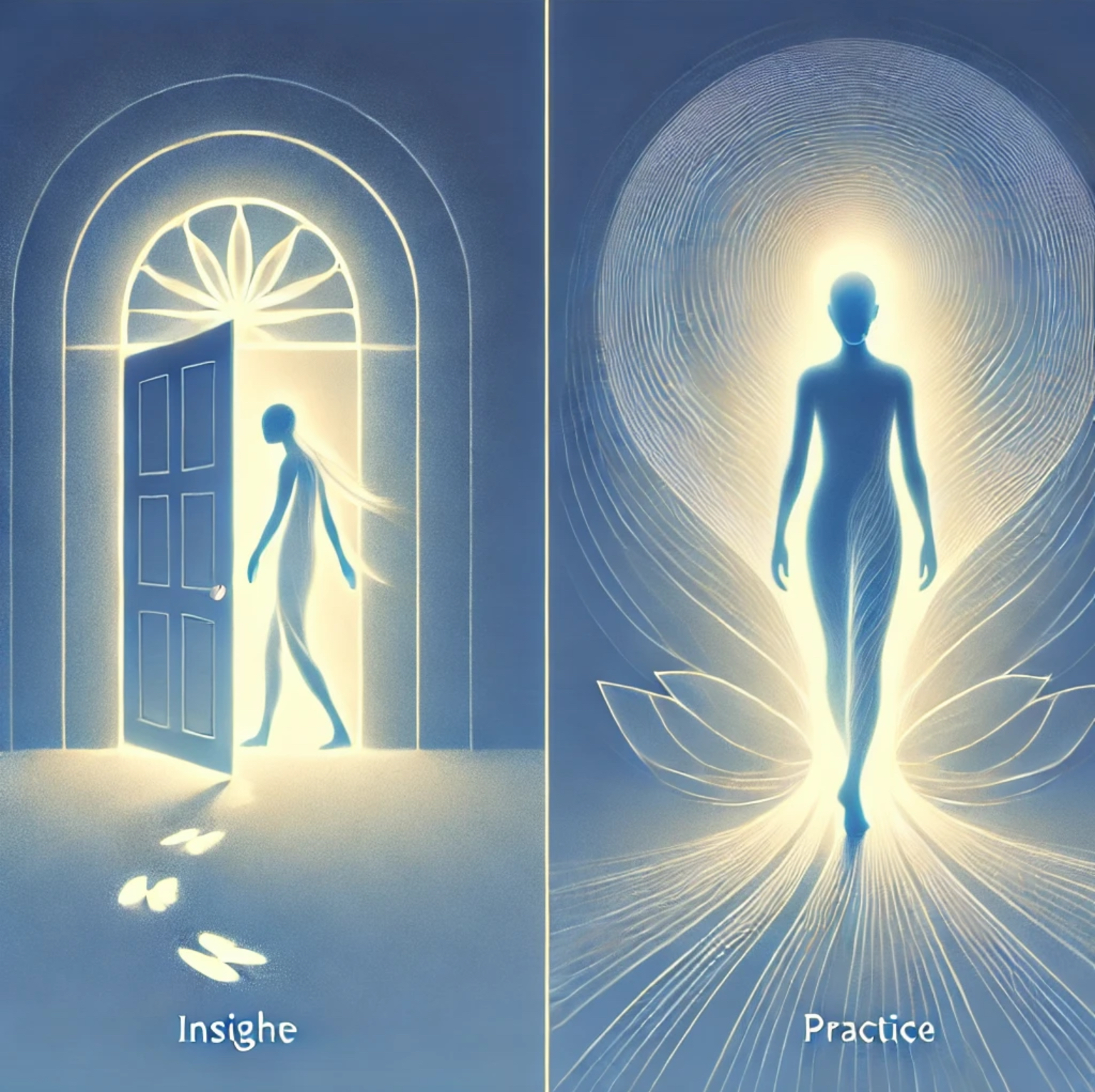

There are moments when we feel expanded.
Clear.
Grounded.
Certain of who we are becoming.
We’ve done the work.
We’ve breathed through old stories.
We’ve grown beyond versions of ourselves we once had to be.
And then we walk into a familiar room.
A family gathering.
An old friendship.
A space that knew us before the shift.
And something subtle happens.
We feel smaller.
Not entirely.
Not consciously.
But something tightens.
And we begin to wonder — why?
That question is what led us to reflect on the nature of energy in relationship.
Everything is energy.
But energy is not just vibration — it is memory.
Every relationship carries an energetic imprint.
People do not just remember who we were.
They hold the energetic frequency of who we were when we were with them.
So when we return to certain spaces, we are stepping into a field shaped by:
- Old dynamics
- Old expectations
- Old survival roles
- Old emotional responses
If our nervous system once learned to:
- shrink
- explain ourselves
- prove our worth
- defend our perspective
- perform to be accepted
that was not weakness.
It was regulation.
At some point in our development — especially within family systems — our bodies learned:
“This is how we stay safe here.”
Maybe shrinking reduced conflict.
Maybe explaining prevented misunderstanding.
Maybe performing earned love.
Maybe defending protected dignity.
Maybe proving secured belonging.
Whatever the strategy was, it worked.
And because it worked, our nervous systems encoded it as stability.
The Body Remembers Before the Mind Does
Long before we had language for growth, trauma, awakening, or embodiment — our bodies were mapping safety.
The nervous system does not operate on philosophy.
It operates on pattern recognition.
It scans:
- Tone of voice
- Facial micro-expressions
- Room dynamics
- Hierarchies
- Emotional tension
And it asks one question:
“What version of us keeps this system calm?”
If historically the calmest version was:
- The agreeable one
- The quiet one
- The achiever
- The spiritual one
- The fixer
- The mediator
That version became the stabilizer.
Not because it was our truest self.
But because it minimized disruption.
Why That Imprint Lives in the Relational Field
Relational fields carry memory.
When we enter a space where we once played a specific role, that role exists as energetic expectation.
It is subtle.
No one may consciously say, “Be who you were.”
But the field recognizes patterns.
And our nervous systems — intelligent and efficient — may begin to shift toward the old configuration. Not because we believe it anymore, but because our bodies remember that configuration as safe.
The system stabilized around that frequency once.
And systems prefer familiarity over truth.
Growth Does Not Immediately Erase Old Regulation
We may have healed.
We may have practiced breathwork, meditation, therapy, prayer.
We may have embodied new clarity.
But growth updates consciousness faster than it updates reflex.
Reflex lives in the body.
So when we return to environments that once required shrinking, our shoulders may tighten before we think.
Our voices may soften before we decide.
We may feel the urge to justify ourselves before anyone challenges us.
Not because we are regressing.
But because our nervous systems are checking:
“Is the old strategy still required?”
That question does not always appear in words.
It shows up as a tightening in the chest.
A quickening of thought.
A subtle scanning of the room.
An impulse to explain before being asked.
The body is not doubting our growth.
It is assessing the environment.
It is measuring tone, posture, familiarity, hierarchy — comparing the present moment to stored memory.
And for a brief second, it prepares the strategy that once kept things stable.
Shrink?
Explain?
Diffuse?
Perform?
The body is simply asking, “What keeps us safe here?”
When we understand this, the moment feels less like failure and more like intelligence.
It is not regression.
It is recognition.
And recognition gives us the space to respond differently.
Frequency as Stabilization
Every family, group, or relational network operates like an ecosystem.
Each member unconsciously occupies roles that maintain balance.
If we were the:
- Peacemaker
- Responsible one
- Spiritual one
- Rebellious one
- Entertainer
- Silent observer
Our frequency contributed to the system’s equilibrium.
When we evolve beyond that role, the system may experience micro-instability.
Not maliciously.
But because its previous configuration no longer fits.
And instability triggers adjustment.
Sometimes that adjustment looks like subtle pressure:
- Jokes about “who we used to be”
- Minimizing our growth
- Ignoring new boundaries
- Provoking old reactions
Not because others are trying to shrink us —
but because systems attempt to restore familiar balance.
The Illusion of Regression
There is an important distinction we often overlook.
When old impulses surface, it can feel like we have gone backward — as though all the work, the awareness, the growth somehow dissolved in a single moment.
But feeling the old impulse does not mean we are the old self.
It means our body recognized a familiar environment.
It means the nervous system detected a pattern it once knew how to navigate.
That recognition is not regression.
It is memory.
And the very fact that we can see it happening — that we can feel the urge to shrink, explain, defend, or perform — is evidence of growth.
Before, we adapted unconsciously.
We shrank without realizing it.
We explained without questioning it.
We performed because it felt automatic.
Now, something different happens.
We feel the impulse — and we notice it.
There is a pause.
A witnessing.
A subtle awareness that says, “This feels familiar.”
That pause is sovereignty.
The pattern may arise, but it no longer owns us.
And in that awareness, we are no longer repeating the past —
we are integrating it.
Updating the Nervous System
The work is not to fight the old imprint.
It is to update it.
Instead of:
- Proving we’ve changed
- Forcing a new identity
- Resisting the pull
We breathe.
We stay in our bodies.
We allow our shoulders to remain open.
We let our voices hold steady.
We respond instead of reflexively adapting.
And slowly, our nervous systems learn:
“We can be expanded here and still be safe.”
Not because the environment changed —
but because we did.
Energy Is Transformed, Not Destroyed
Energy cannot be created or destroyed — only transformed.
Emotion follows a similar principle.
Shame can transform into humility.
Fear into awareness.
Anger into clarity.
Grief into depth.
Transformation seems to require space — not force.
When we try to push against old energy, to overpower it or silence it, something inside us tightens. Resistance meets resistance. And that friction can keep the very pattern we are trying to escape alive.
But when we meet old energy with awareness instead of opposition, something subtler happens.
We create room.
Room to feel without collapsing.
Room to observe without reacting.
Room to choose without proving.
And in that space, the energy does not have to be fought.
It can shift.
It can soften.
It can reorganize itself in ways that feel less like battle and more like integration.
Perhaps that is how transmutation actually occurs — not through domination, but through presence.
The Practice of Holding Frequency
Instead of proving our growth, we can practice holding it.
We sit in our knowing.
We let our bodies soften.
We breathe slowly.
We observe the energy in the room without absorbing it.
We do not have to argue our expansion.
We do not have to announce our awareness.
We do not have to demonstrate our healing.
We simply remain.
Embodiment is quiet.
Stable.
Grounded.
It does not need applause.
Remembrance as Regulation
When we leave environments that feel contracting, we can return to evidence of our evolution:
- Photos from milestones
- Letters from people we’ve helped
- Words we’ve written
- Breakthroughs we’ve documented
- Work we’ve completed
These are not ego reinforcements.
They are anchors.
They remind our nervous systems:
We have grown.
We have endured.
We have expanded.
We are not who we were.
And we do not need to collapse to make others comfortable.
Others are not necessarily trying to change us.
They may simply be responding to the last stable version of us they knew.
When our frequency shifts, it can feel unfamiliar — even destabilizing — to a system accustomed to our previous role.
That does not make anyone wrong.
It simply means the field is adjusting.
Our task is not to dominate the energy.
Our task is to hold our own.
And when we do — without force, without proving — we discover something powerful:
Growth does not need witnesses to be real.
It needs embodiment.
And embodiment is quiet.
J Emanuel Hodge