
Be Careful What You Entertain
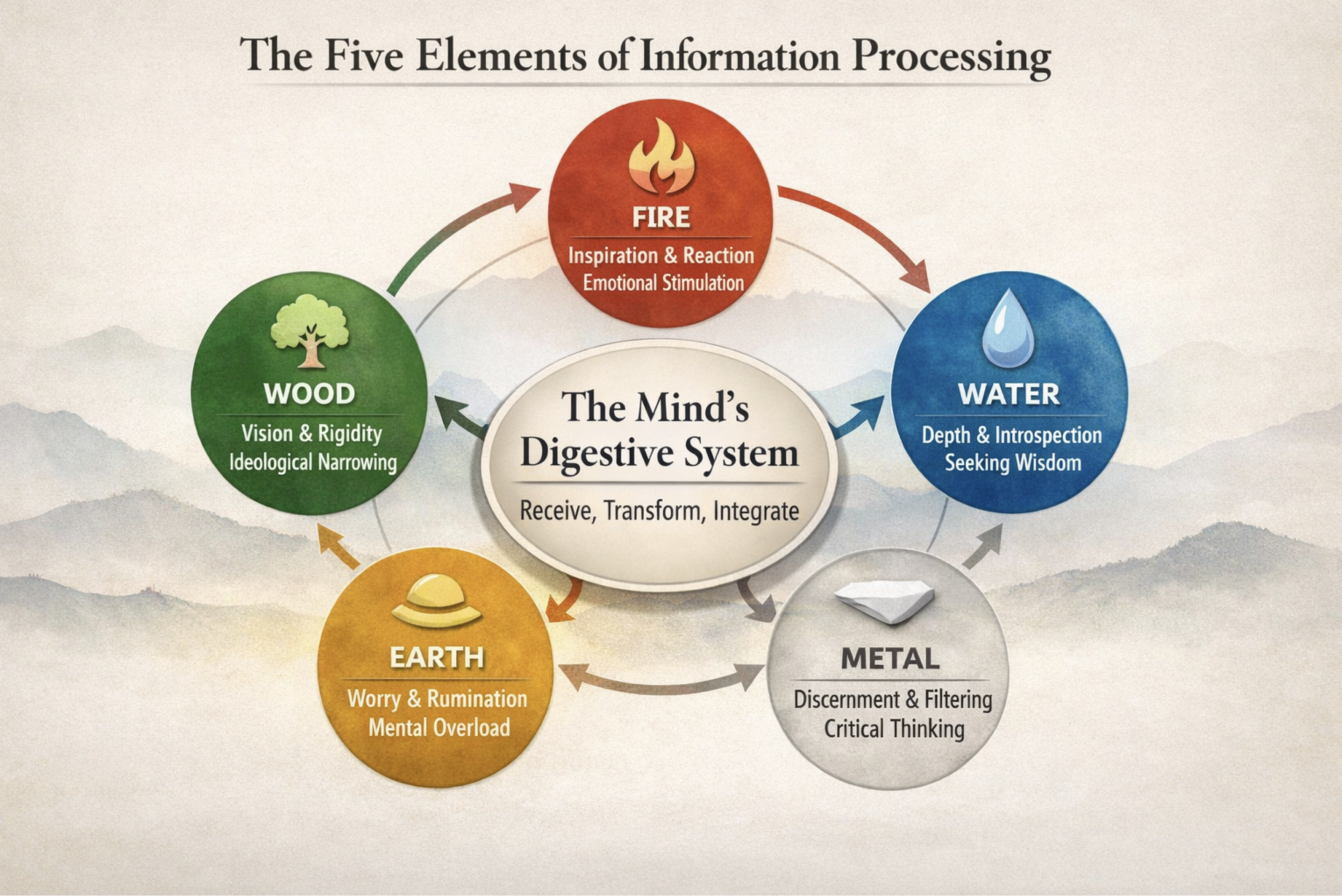
The Mind Also Digests Information
Recently someone sent me a message suggesting that artificial intelligence is making people less intelligent.
I didn’t even open the article, but the statement itself lingered for a moment. Not because I agreed with it, but because it prompted a deeper question:
What is information actually doing to our minds?
We are often careful about what we put into our bodies—at least in principle—yet far less careful about what we allow into our minds.
There is a quiet truth about the mind that many people overlook.
Just as the body becomes what it repeatedly eats, the mind becomes what it repeatedly entertains.
Every conversation we engage in, every article we read, every video we watch, every idea we allow to circulate through our thoughts becomes part of our internal environment.
Some of these inputs nourish clarity and expansion. Others create confusion, agitation, or stagnation.
In the modern world we are surrounded by an endless stream of information. Opinions, headlines, theories, and arguments arrive constantly.
Yet many people rarely stop to ask a simple but powerful question:
What is this information doing to my mind?
Not all information nourishes the same way.
Some expands perception.
Some strengthens discernment.
Some inspires creativity.
But some information clouds the mind, triggers unnecessary fear, or traps us in repetitive cycles of thinking.
Learning to recognize the difference is a form of mental hygiene — and perhaps even a form of spiritual cultivation.
The Digestive System of the Mind
The Stomach receives.
The Spleen holds, transforms, and transports.
Physically, the stomach accepts food and drink. It is the great receiver of nourishment, beginning the process of breaking down what enters the body so that it can be further refined and assimilated.
The spleen then performs the essential work of transformation. It extracts the usable essence from what has been consumed and converts it into Qi and Blood—the subtle substances that sustain vitality and nourish the entire body. Through this process, nourishment is distributed where it is needed so that the body can function with strength and clarity.
But the spleen’s role does not end with transformation. In traditional Chinese medicine, the spleen is also responsible for holding and stabilizing. It keeps things properly contained and organized within the body. When the spleen’s Qi is strong, it helps keep the blood within the vessels, supports the proper position of the organs, and regulates the upward movement of clear nourishment throughout the body.
When the spleen becomes weakened or overwhelmed, this holding function can falter. The body may struggle to properly contain and organize what it has received. In clinical terms this may manifest as issues such as loose stools, a tendency toward fatigue or heaviness, difficulty maintaining proper fluid balance, or even forms of prolapse when the lifting and holding aspect of spleen Qi becomes deficient.
In other words, what should have been transformed into nourishment and stability instead becomes stagnation, leakage, or collapse.
This same principle can also be applied to the mind.
Just as the body has a digestive system for food, the mind has a digestive system for information and experience.
The Mental Stomach: Receiving the World
The mind is constantly receiving impressions from the environment. These impressions enter through our senses and through our attention.
In this metaphor, we can think of the mental stomach as the part of the mind that receives information.
The mental stomach takes in:
• conversations
• news and media
• social media feeds
• books and teachings
• opinions and interpretations
• personal experiences
• emotional environments
• cultural narratives
Just as the physical stomach does not immediately discriminate between nourishing food and food that may ultimately burden the body, the mind also begins by simply receiving whatever it is exposed to. The senses open the gate, and impressions enter.
The eyes receive images.
The ears receive sounds and words.
The mind receives ideas, narratives, and interpretations.
In this way, the mind functions very much like a stomach for experience.
Everything we watch, read, listen to, and discuss is taken in as mental substance. Conversations, headlines, social media feeds, books, teachings, opinions, emotional environments, and even the tone of the people around us all become part of what the mind is digesting.
At the moment of reception, the mind does not yet determine whether what it has received will ultimately nourish or burden us. Just as the stomach begins digestion before the body fully determines the value of the food, the mind initially accepts impressions before it evaluates them.
This is why attention is one of the most powerful forms of nourishment we possess.
Where attention goes, experience enters.
And whatever repeatedly enters our awareness gradually becomes the raw material from which our internal landscape is constructed.
Our beliefs, emotional tendencies, expectations, and even our sense of possibility are shaped by what we consistently allow to circulate through our minds. Over time, repeated exposure becomes internal structure.
Ideas become assumptions.
Assumptions become perspectives.
Perspectives become the lens through which we interpret reality.
For this reason, the cultivation of awareness requires more than simply learning new information. It also requires learning to be mindful of what we repeatedly allow into the mouth of the mind.
In this way, the quality of the impressions we repeatedly absorb gradually shapes the structure of our thinking and the tone of our inner world.
The Mental Spleen: Transforming Meaning
Once information is received, another process begins.
The mental spleen represents the mind’s ability to transform raw information into understanding.
This process involves several subtle functions:
• interpreting meaning
• organizing ideas
• forming beliefs
• identifying patterns
• creating perspective
• integrating experiences
• extracting wisdom
This is the stage where information stops being merely something we heard and begins becoming something we understand.
In other words:
Information becomes knowledge.
Knowledge becomes insight.
Insight eventually becomes wisdom.
When the mental spleen is functioning clearly, we are able to calmly examine ideas, reflect on them, and integrate what is meaningful.
The mind becomes stable, thoughtful, and perceptive.
But like the physical spleen, the mental spleen can become overloaded.
When the Mind Cannot Digest
In Chinese medicine, when the Spleen becomes overwhelmed or weakened it begins to produce what is known as dampness.
Dampness is a condition of heaviness, stagnation, and accumulation. It slows movement, obstructs clarity, and prevents proper transformation.
In the body, the Spleen’s role is to transform food and fluids into usable nourishment. When this transformation process becomes impaired, substances that should have been refined and circulated begin to accumulate and congeal.
Instead of becoming energy, nourishment becomes residue.
This residue is referred to as dampness.
Physically, dampness often manifests as:
• fatigue
• sluggish digestion
• a feeling of heaviness in the limbs or body
• mental fog
• bloating or fluid retention
• difficulty feeling energized even after rest
Dampness does not move easily. It lingers. It accumulates. It weighs down the system.
And because it obstructs the clear movement of Qi, it gradually begins to cloud both physical vitality and mental clarity.
Mentally, dampness can appear as a kind of cognitive heaviness.
The mind begins to feel thick, cluttered, and overburdened.
Thoughts lose their sharpness.
Perception becomes less precise.
Discernment becomes more difficult.
When the mind receives more information than it can meaningfully process, the mental digestive system becomes congested in much the same way the physical digestive system does when it receives more food than it can transform.
Information accumulates faster than it can be integrated.
Instead of transforming information into understanding, the mind becomes stuck in repetitive processing.
Thoughts circulate without resolution.
Questions repeat themselves without insight.
This is often experienced as:
• overthinking
• rumination
• confusion
• difficulty discerning truth from noise
• mental fatigue
• scattered attention
• emotional reactivity
• difficulty forming clear conclusions
Ideas accumulate without being properly integrated.
The mind keeps chewing on information without ever fully digesting it.
And just like physical indigestion, when the mind is overloaded it does not gain nourishment from what it has consumed.
Instead, it becomes weighed down by it.
In the modern world this condition has become increasingly common.
Our mental stomach is constantly receiving information — headlines, notifications, conversations, opinions, images, alerts, and emotional narratives — often at a pace far faster than the mind can transform them into meaningful understanding.
Without time for reflection, contemplation, and integration, the mind becomes informationally saturated.
The result is a subtle but widespread form of mental dampness.
People do not necessarily lack intelligence.
Rather, their cognitive system is simply carrying more unprocessed input than it was designed to handle.
The mind becomes busy, but not necessarily clear.
Full, but not necessarily nourished.
And like the body after overeating, what the mind often needs most in this state is not more input — but time to digest.
The Importance of Mental Digestion
If the mind has a digestive system, then it also requires time to digest what it receives.
In the same way that the body cannot properly process food when meals are constant and uninterrupted, the mind cannot fully integrate information when it is continually fed new impressions. When intake becomes continuous, transformation slows down.
This is where many people struggle in the modern information environment. The mind is rarely allowed to complete its natural cycle of reception, transformation, and integration. Instead, new ideas arrive before earlier ones have settled into understanding.
Mental digestion requires space.
It is within this space that the mind organizes what it has received, distinguishes signal from noise, and refines meaning. What initially entered as raw information begins to clarify into insight.
Reflection allows the mind to examine ideas from multiple angles.
Contemplation allows patterns and relationships to become visible.
Stillness allows deeper understanding to surface naturally.
Without these pauses, the mind remains in a state of continuous intake, where thoughts accumulate faster than they can be integrated. The result is not necessarily ignorance, but unfinished thinking — ideas that circulate without resolution.
Clarity emerges when we allow the mind to complete the process of digestion.
This means occasionally stepping back from the stream of incoming information and engaging the quieter work of internal processing. Rather than immediately absorbing the next idea, we pause long enough to consider what has already been received.
In this process we begin asking questions such as:
What in this is truly useful?
What carries genuine meaning?
What aligns with deeper understanding?
What can be released without further attention?
Through this kind of inquiry, information is refined into knowledge, and knowledge gradually matures into wisdom.
Mental digestion, therefore, is not simply a passive process. It is an intentional practice of discernment—a way of allowing the mind to transform what it receives into something that genuinely nourishes understanding.
Nourishing the Mind
Once we recognize that the mind digests information much like the body digests food, our relationship with information begins to change.
We become more attentive to what we are feeding our awareness.
Just as a healthy body depends not only on digestion but also on the quality of the food consumed, a healthy mind depends on the quality of the ideas and impressions it repeatedly encounters.
Over time we begin to see that not every idea deserves equal space within our attention.
Some information expands understanding.
Some stimulates curiosity and insight.
Some strengthens discernment.
But other information merely agitates the mind, clouds perception, or traps attention in cycles of reaction.
Learning to nourish the mind therefore involves more than accumulating knowledge. It requires developing a sensitivity to what truly contributes to clarity.
We begin to notice what leaves us feeling grounded, thoughtful, and expanded — and what leaves us feeling scattered, heavy, or reactive.
In this way, discernment becomes a form of intellectual nutrition.
Just as the body thrives when it receives wholesome nourishment, the mind thrives when it repeatedly encounters ideas that encourage reflection, curiosity, creativity, and deeper understanding.
Clarity of thought does not arise simply from learning more.
It often begins by learning what not to entertain.
And perhaps one of the most important realizations in this process is that attention itself is nourishment.
Whatever we repeatedly give our attention to gradually shapes the architecture of our inner world.
What we repeatedly entertain, we slowly become.
Information as a Form of Nutrition
If we begin to think of information as a form of nourishment, an important realization emerges: not all information feeds the mind in the same way.
Just as the body responds differently to different types of food, the mind responds differently to the ideas, conversations, and impressions it repeatedly consumes. Some inputs strengthen clarity and understanding, while others merely stimulate the mind briefly without contributing to deeper growth.
Certain forms of information resemble what we might call mental junk food. They provide quick stimulation but little substance. Sensational headlines, outrage-driven media, shallow commentary, and endless streams of distraction often fall into this category. Like sugary foods for the body, they can create short bursts of attention or emotional reaction, but they rarely leave the mind more nourished or grounded afterward.
Other forms of information are neutral. Routine updates, everyday conversations, entertainment, and general news may serve a practical role in keeping us connected to the world around us. They are not inherently harmful, but neither do they necessarily contribute significantly to intellectual depth or personal insight. Much like simple staple foods, they sustain basic functioning without dramatically strengthening the system.
Then there is information that can truly be described as nourishing.
This type of information does more than capture attention—it deepens perception. It encourages reflection, broadens perspective, and invites the mind to explore relationships between ideas. Philosophy, scientific inquiry, meaningful dialogue, spiritual teachings, creative exploration, and thoughtful contemplation all belong in this category. Rather than merely filling the mind with more content, these forms of engagement cultivate the mind’s ability to recognize patterns, refine understanding, and integrate experience into wisdom.
Over time, the quality of the information we consume begins to shape the structure of our thinking. Repeated exposure to shallow stimulation tends to produce shallow patterns of attention. Repeated exposure to thoughtful ideas, however, encourages depth, patience, and discernment.
In this way, the mind gradually becomes conditioned by its informational environment.
Just as the body benefits from a balanced and thoughtful diet, the mind benefits from an intentional information diet—one that includes space for curiosity, learning, reflection, and meaningful conversation. When we become mindful of what we are regularly feeding our awareness, we begin to see that intellectual and emotional clarity are not accidental.
They are cultivated.
The mind, like the body, is constantly being shaped by what it consumes. The difference lies in whether that nourishment supports momentary stimulation—or long-term understanding.
The Five Elements and Patterns of Thought
Chinese medicine teaches that the Five Elements describe not only the functioning of the body, but also patterns within the mind. Each element corresponds to particular organs, emotional tendencies, and cognitive processes.
In other words, the Five Elements can also be understood as five ways the mind engages with experience and information.
When these systems are balanced, perception becomes clear, thoughtful, and adaptive. When they become excessive or depleted, our thinking can become distorted in subtle ways.
Understanding these patterns can help us recognize how different types of information influence our internal state.
Earth — Reflection and Integration
The Earth element governs the Spleen and Stomach, the very organs responsible for receiving and transforming nourishment.
On the psychological level, Earth represents the mind’s capacity for reflection, integration, and meaning-making. It is the cognitive process that allows us to take in experiences and slowly convert them into understanding.
When Earth energy is balanced, the mind is steady and thoughtful. Ideas are examined patiently. Information is digested rather than rushed. A person is able to absorb knowledge without becoming overwhelmed by it.
However, when Earth becomes burdened or overstimulated, reflection can turn into rumination. The mind begins to circle around the same ideas repeatedly without reaching clarity. Thoughts become sticky and repetitive, much like undigested food lingering in the body.
In an age of constant information flow, Earth energy is easily overloaded. The mind keeps chewing on new inputs without ever completing the process of integration.
Wood — Vision and Direction
The Wood element corresponds with the Liver, which in Chinese medicine is responsible for the smooth movement of Qi throughout the body.
Psychologically, Wood represents vision, strategy, and directional thinking. It allows the mind to organize information, identify possibilities, and move ideas forward into purposeful action.
When Wood energy is balanced, a person can synthesize information and use it constructively. Ideas become plans. Knowledge becomes movement. The mind remains flexible and capable of adapting to new perspectives.
But when Wood energy becomes constrained or excessive, thinking can become rigid or combative. Instead of exploring possibilities, the mind becomes attached to a single interpretation.
In the modern information environment, this can appear as ideological fixation—where individuals cling tightly to one narrative and react with frustration or hostility toward alternative viewpoints.
Healthy Wood energy, by contrast, allows ideas to remain dynamic and evolving.
Fire — Inspiration and Connection
The Fire element corresponds with the Heart, which houses the Shen—the spirit or consciousness.
Psychologically, Fire governs emotional resonance, enthusiasm, and the ability to connect ideas with meaning and inspiration. It is the spark that allows knowledge to become alive and engaging.
When Fire energy is balanced, ideas inspire curiosity, creativity, and meaningful dialogue. Information does not remain purely intellectual—it becomes something that touches the heart and motivates exploration.
However, when Fire becomes overstimulated, the mind can become excitable and reactive. Emotional stimuli begin to dominate perception.
In the modern media environment, this is easy to see. Sensational headlines, emotionally charged narratives, and constant stimulation can keep the mind in a state of heightened reaction.
Instead of thoughtful contemplation, attention jumps rapidly from one emotional trigger to another.
Balanced Fire inspires understanding.
Excess Fire amplifies reaction.
Metal — Discernment and Clarity
The Metal element governs the Lungs and Large Intestine, organs associated with taking in what is essential and releasing what is unnecessary.
Psychologically, Metal represents discernment, refinement, and intellectual boundaries.
It is the capacity to evaluate information carefully and distinguish what is meaningful from what is merely noise.
When Metal energy is strong, a person is able to filter ideas effectively. They listen carefully, question assumptions, and retain what contributes to understanding while letting go of what does not.
This process mirrors the physiological function of elimination. Just as the body must release waste to remain healthy, the mind must release unhelpful ideas in order to remain clear.
When Metal energy is weakened, however, discernment becomes dull. A person may absorb every opinion or claim they encounter without examining its validity.
Without the filtering function of Metal, the mind becomes cluttered with unrefined information.
Water — Depth and Wisdom
The Water element corresponds with the Kidneys, which in Chinese medicine are associated with essence, memory, and the deepest reserves of vitality.
Psychologically, Water governs depth, introspection, and the capacity for profound understanding.
Water allows the mind to descend beneath the surface of ideas. It invites contemplation, patience, and the willingness to explore the unknown.
When Water energy is balanced, the mind becomes comfortable with complexity. It can sit with unanswered questions and allow insight to emerge gradually.
But when Water energy becomes depleted, the mind often seeks quick certainty instead of deeper understanding. Surface-level explanations become more appealing than patient inquiry.
In the modern world, where information is delivered instantly and answers are expected immediately, this deeper mode of reflection is easily neglected.
Yet many of the most meaningful insights in life arise only when the mind is willing to enter the slower, quieter currents beneath immediate information.
Seeing the Whole System
Together, these five elements describe a complete ecology of thinking.
Earth receives and integrates.
Wood organizes and directs.
Fire animates and inspires.
Metal refines and discerns.
Water deepens and contemplates.
When these processes remain balanced, information flows through the mind in a healthy cycle, eventually transforming into wisdom.
But when one of these functions becomes excessive or neglected, our thinking can become distorted in ways that are often subtle but powerful.
Understanding these patterns helps us recognize that clarity of thought is not simply a matter of intelligence.
It is also a matter of internal balance.
The Difference Between Consuming and Contemplating
One of the most important distinctions we can make in the modern world is the difference between consuming information and contemplating information.
Consumption is passive.
Contemplation is active.
Passive consumption often leads to confusion because ideas are accepted without digestion.
Contemplation, however, allows the mind to transform information into understanding.
This is the work of the mental spleen.
It is the process through which information becomes knowledge, and knowledge eventually becomes wisdom.
Tools Do Not Determine Intelligence
Occasionally we hear the claim that modern tools—particularly artificial intelligence—are making people less intelligent. The argument usually suggests that if a machine can answer questions quickly, people may stop thinking for themselves.
But this perspective overlooks an important principle that has appeared throughout human history: tools themselves do not determine intelligence. What they tend to do instead is amplify the habits and intentions of the person using them.
A tool is ultimately neutral. It extends a capability, but it does not dictate how that capability will be used.
We have seen this pattern many times before. When calculators became common, some people worried that mathematical thinking would disappear. When search engines emerged, there were concerns that people would stop learning because answers were instantly available. Even the printing press once raised fears that memory and scholarship would decline.
Yet each of these technologies ultimately did two things simultaneously. They made it easier for some people to avoid effort—but they also gave curious minds new ways to explore ideas more deeply than ever before.
Artificial intelligence appears to be following the same pattern.
A passive user may approach such tools as a shortcut. They may ask for quick answers without reflection, accepting whatever response appears without questioning it. In this case, the tool simply reinforces habits of intellectual passivity. The person becomes a consumer of answers rather than an investigator of ideas.
But a curious mind approaches tools differently.
Instead of seeking immediate conclusions, the curious mind uses tools to extend inquiry. It asks deeper questions. It explores multiple perspectives. It refines ideas through dialogue and examination. The tool becomes less like a calculator and more like a thinking partner that stimulates exploration.
In this context, technology does not replace thinking—it expands the range of contemplation.
A person might use it to:
- examine patterns across different disciplines
- explore philosophical or scientific questions from multiple angles
- refine writing and clarify ideas
- test assumptions and challenge their own thinking
When used in this way, the tool becomes a catalyst for deeper reflection rather than a substitute for it.
This is why the conversation about intelligence and technology often misses the deeper point. The real question is not whether tools make people more or less intelligent. The real question is how people choose to engage with them.
Tools amplify tendencies.
If someone approaches them with curiosity, they can become instruments of learning and intellectual expansion. If someone approaches them with impatience or passivity, they may simply reinforce shallow habits of thought.
In this sense, intelligence is not determined by the tools available to us but by the quality of attention we bring to their use.
Just as the body becomes what it repeatedly consumes, the mind becomes shaped by the way it interacts with information and inquiry. A thoughtful mind uses tools to deepen understanding. A passive mind uses tools to avoid it.
The difference lies not in the tool itself, but in the consciousness of the user.
The Discipline of Attention
Attention is one of the most powerful resources we possess, yet it is often treated as though it were limitless. In reality, attention is finite. It is the channel through which experience enters the mind and where energy is directed within our lives.
Where attention goes, energy tends to follow.
What we repeatedly focus on gradually shapes the architecture of our inner world. Over time, the subjects we give our attention to begin to influence our emotional tone, our assumptions about life, and the way we interpret events around us. Attention becomes the gateway through which thoughts form patterns and patterns eventually form perspectives.
For this reason, protecting attention is not an act of isolation or avoidance—it is an act of self-cultivation.
It involves becoming more conscious of what we allow to occupy the space of our awareness. The books we read, the conversations we repeatedly engage in, the media we consume, and the ideas we entertain all contribute to the environment of the mind.
This does not mean withdrawing from the world or refusing to engage with difficult realities. Rather, it means developing the wisdom to recognize when attention is being scattered, overstimulated, or drawn toward agitation rather than understanding.
A well-cultivated mind is not one that avoids the world, but one that learns to direct its attention deliberately, choosing nourishment over noise and clarity over constant stimulation.
Becoming the Observer of Ideas
One of the most liberating shifts in consciousness occurs when we realize that we are not obligated to adopt every idea that passes through our awareness.
Thoughts, opinions, and interpretations arise constantly within the mental environment. They appear through conversations, media, cultural narratives, and even through our own internal reflections. But just because an idea appears within the mind does not mean it must be accepted or absorbed.
We can learn to observe ideas the way we observe clouds moving across the sky.
Some clouds are dense and worth studying.
Some are fleeting and quickly dissolve.
Some signal important changes in the atmosphere.
Others simply drift by without consequence.
In the same way, ideas can be witnessed without immediately becoming part of our identity or belief system.
This capacity to observe without instantly identifying with every thought is a form of intellectual and spiritual maturity. It allows us to remain open to new perspectives while still maintaining discernment.
Instead of reacting immediately to every idea that appears, we gain the ability to pause, examine, and reflect. The mind becomes less reactive and more spacious.
In that space, clarity has room to emerge.
A Simple Truth
At the heart of all these reflections lies a simple but powerful truth:
Just as the body becomes what it repeatedly eats, the mind becomes what it repeatedly entertains.
Every idea we repeatedly expose ourselves to gradually leaves an imprint on our thinking. Over time, these impressions accumulate and begin shaping how we perceive reality.
Some information nourishes clarity.
Some produces confusion.
Some expands perception and invites deeper understanding.
The mind is constantly being shaped by what it consumes, whether we realize it or not.
Wisdom begins when we recognize that attention itself is a form of nourishment. What we allow into the field of our awareness becomes the raw material from which our thoughts, beliefs, and perspectives are formed.
And like food entering the body, not everything that reaches the mouth of the mind should be swallowed without reflection.
Discernment allows us to pause before accepting what we encounter. It reminds us that nourishment is not simply about quantity, but about quality.
In learning to choose what we entertain carefully, we begin cultivating a mind that is clearer, steadier, and more capable of genuine understanding.
And just as the body depends on proper nourishment and digestion to sustain life, the mind depends on the careful selection and thoughtful transformation of ideas—because what we continually receive, digest, and integrate quietly becomes the substance of our understanding and the foundation of our wisdom.
